Link to the audio version of this post is HERE

There are days you dread because you know they’ll happen some time in the distant future. They’re inevitable, but they’re far off; they’re barely real. Then there are those days you dread so much that even the stray thought of it popping into your head in an absentminded moment can be enough to ruin your day. For me, this is one of those days. This is going to be hard to write.
I know of Patrick Stewart’s work mostly through Star Trek: The Next Generation. It was an ever-present show through my childhood, one of the ones I would come home from school and watch before homework and dinner, along with MacGyver and The A-Team. It was a show that, ultimately, taught me a lot about the world and how I want to find my way through it. Not what I wanted to do in life, which is certainly not space exploration or military service, but rather how I wanted to go through life. And the thought and care with which I treat others as I have my brief cameos in their stories.
A lot of that is from Captain Jean-Luc Picard, of the USS Enterprise. It’s probably the role he’s most famous for, so it’s not like I have to tell you about him, but I think I’m going to anyway. You see, Kirk was a roll-up-your-sleeves and punch-your-way-out kind of captain, but Picard wasn’t. Picard was a thinker. Reserved, wise, thoughtful; but he was also kind and caring, decisive and authoritative.
In a group chat with old friends, one of them sent a tribute to Patrick Stewart. The clip of him speaking to Data that’s been making the rounds about how you can make no mistakes and still lose. The chat then filled up with messages from myself and everyone else about how Jean-Luc Picard played an important role in our lives, how he made competence and kindness look like the same thing, how The Next Generation was a show full of characters you could look up to and all those characters looked up to Picard. And these were my friends’ words. The group of us, all millennial men, reminisced about how this one character, played by this genuinely kind man, taught us what being a man was all about. And it was never about who was the fastest to anger or loudest in a shouting match, never the strongest in a fight, never the most dug-in and close-minded. It was about approaching people with curiosity and a willingness to learn and seeing things from their perspective. Picard was Ted Lasso before Ted Lasso, he was Mr. Rogers in the vast and empty celestial black, he was Aragorn in a starship. Strong, healthy masculinity that makes room for others rather than taking up all the space for himself. Leadership isn’t about dominance, it never has been. It reminds me of the idea of the alpha male, modeled off of wolf packs. Scientist David Mech, who made the observation of a dominant male ruthlessly above the others in the pack was absolutely incorrect, based on faulty observations of wolves in captivity without their packs, and he spent decades trying to correct this misinterpretation of behavior. In reality, the “alpha” of a wolf pack is more often than not simply a father wolf teaching his young how to be a wolf and do wolf stuff. It’s not a position of dominance; it’s a position of nurturing. The truth said second, however, is unfortunately far less effective than the mistruth said first. So this myth of the alpha lives on even today in the form of manosphere influencers and general toxic masculinity, despite the book in which the term was coined was replaced by Dr. Mech with one that’s actually accurate. The most alpha thing you can actually do is teach the ones younger and smaller and weaker than you, to help them grow and eventually surpass you.
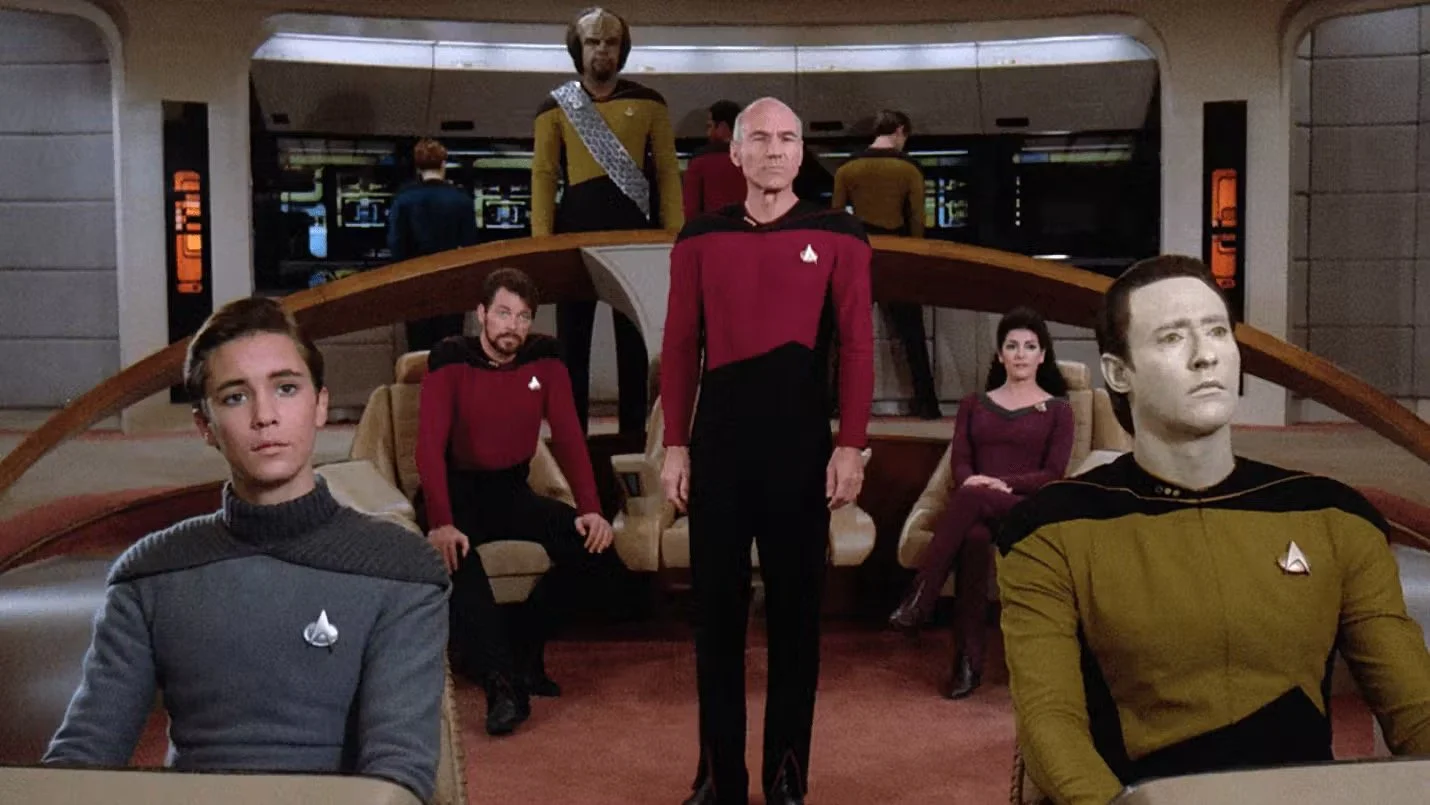
And that’s who Jean Luc-Picard was. I understand that I’m writing a eulogy for a man by talking about a character he played, but that’s how real Stewart made Picard. When Patrick Stewart was cast as Professor Xavier in the original X-Men movies, I said “What’s Captain Picard going to do with the X-Men?” The two are inseparable for me and maybe that’s a failing, but if there’s someone you’re going to admire this deeply based on a work of fiction, Captain Picard and Patrick Stewart may be the right pair to go all-in on. Stewart grew up in an abusive household, with a father who survived the Battle of Dunkirk, but came home changed. Like many veterans, the horrors of war stayed with Stewart’s father and society hadn’t progressed in a way that it was able to help him cope. In the US, it was called shellshock. In England, they called it combat fatigue. Now, we call it PTSD. And untreated, PTSD can result in all sorts of issues. I’m not an expert and I won’t pretend to be, but the long and short of it is that Stewart’s father took it out on him and on Stewart’s mother. Physically and violently. Domestic violence takes a toll on people far beyond the seen; the emotional scars of pain inflicted by someone meant to protect you are deep, numerous, and often invisible. But Stewart was undaunted. He pushed through, not just surviving, but finding theater and acting and going on to become one of the most respected actors in history. He found his passion, worked tirelessly at it, and became one of the best and most influential to do it.
But that wasn’t all he did. He spoke out against domestic violence. He spoke about the toll it takes on its victims. And he didn’t let hate cloud his feelings. He supported the UK charity Refuge for abused women, like the mother he wanted to protect, but couldn’t. But he also supported the organization Combat Stress, a charity that aims to help members of the British Armed Forces receive mental health treatment, including treatment for the PTSD that his father suffered from and was unable to receive treatment for. He hated what happened to his father, he hated how it changed him, he hated what he did. But it didn’t seem like he hated the man. Even now, Patrick Stewart continues to teach me lessons. I may never be as good a man as he was, but I can spend the time I have left trying to be. Stewart even spoke out on behalf of pit bulls, dogs that are illegal in the UK since 1991 and can be seized and euthanized by the UK government. I used to sit for a pit bull called Rocky and I very quickly realized that these sweet, misunderstood animals aren’t to blame for their reputation. Imagine my surprise when this vicious animal came and sat on my foot when it rained because it scared him. Not exactly the behavior of a natural born killer, is it? Patrick Stewart didn’t just entertain, he spent his life in service of others. For those who couldn’t speak for themselves. Human and animal. Even before he was Jean-Luc Picard, he embodied the lessons that he’d go on to model for a whole generation. My generation.
Who you are matters. It matters more than just how you’ll be remembered or whether you’ll be mourned. It matters the lives you touch while you’re still here. And Patrick Stewart touched millions of lives in a lasting and meaningful way that will never be forgotten. I couldn’t point to one moment in The Next Generation that made me love Picard. Because there are too many. Maybe it was his defense of the android Data against Starfleet. Maybe it was when he was stranded on a planet with an alien life form that only spoke in examples and he had to be open to finding a way that they could communicate with each other to survive. Maybe it was that lesson he imparted to Data, that you can do everything right and still lose. That it doesn’t take a mistake to mean you don’t win and that’s just life. Maybe it’s one of hundreds more moments. Or maybe it’s the totality of it. Maybe it’s that at every turn, every time I put The Next Generation on after school, or secretly watched it at work in the time when Netflix could still get through network security, or again several times after that, he’s been a positive role model for everyone who was paying attention, of any gender. But personally, in the light of all this manosphere, misogynistic garbage that so many men peddle for their own financial benefit to the detriment of women and the detriment of the young men who listen to them, I am so glad that I grew up with a man like Patrick Stewart and a captain like Jean-Luc Picard to look up to. The reason I pay this much attention to media, the reason I analyze it, the reason I put so much stock into the messages, intended or otherwise, by media is because we are a bundle of our influences. Our home life, school, friends, media, and now social media are all part of the mix. And if we ingest garbage constantly, if we allow ourselves to be bombarded by messages that encourage us to hate, it won’t be long until deep down we become garbage too. Men like Patrick Stewart show us what masculinity really means. And the lessons he imparted are there for all of us to learn.
Ad Astra Per Aspera, Captain. Rest well. I will miss you for the rest of my time and your example will never be forgotten.